// visual proof
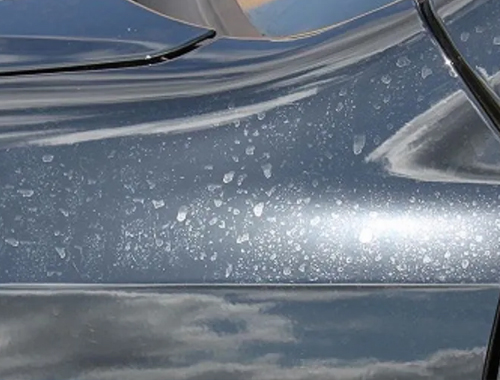
Before
Mineral water spots embedded in clear coat — etched by calcium deposits after evaporation.
After
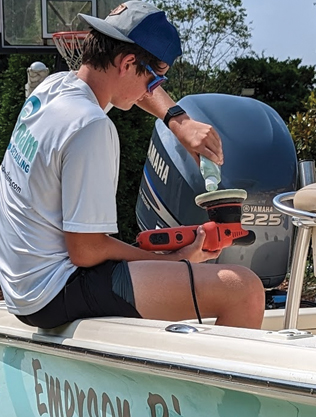
DA machine polish removes the etched layer, restoring mirror-flat clarity and gloss depth.
What We Fix
Most paint defects live in the clear coat — the top 2–3 microns. Machine polishing removes exactly that layer, correcting the defect without harming the paint beneath.
Calcium and mineral deposits that etch into clear coat when water evaporates. Polishing removes the etched surface layer completely.
Fine circular scratches from improper washing technique or automatic car washes. Polishing flattens the peaks, eliminating the haze they create in light.
Scratches that haven't broken through to base coat. Aggressive compound followed by finishing polish removes them entirely from the clear coat.
Distinct arcing marks left by rotary polishers used incorrectly. Common on dealer-prep jobs. Our DA technique corrects these without introducing new marring.
UV degradation that turns paint chalky, dull, or faded. A cutting compound removes the oxidized surface and reveals the undamaged paint underneath.
Foreign paint rubbed onto your car's surface. Clay bar decontamination followed by polishing removes it without touching your own paint underneath.
Correction Levels
The right stage depends on your paint's condition. We assess every car before quoting — no guesswork.
Light Correction
Full Correction
Concours Correction
Your clear coat is 40–80 microns thick. Defects like swirls and water spots only live in the top 2–4 microns. Paint correction uses progressively finer abrasives — mounted on a DA machine polisher — to remove exactly that thin layer.
The result is a flat, optically perfect surface that reflects light without distortion — the definition of a "corrected" finish.
Protect it after with Ceramic Coating →// Clear Coat Depth Model
← This is what we remove
✓ 95% remaining — fully safe
A properly done correction removes no more than 1–3µm per pass. Multiple corrections over years of ownership are safe. We measure paint thickness before and after to confirm.
FAQ
No — when done correctly. We use a DA (dual-action) polisher rather than a rotary, which eliminates the risk of burning through paint. We also measure paint thickness before starting and track material removed per pass.
Only scratches in the clear coat. If you can feel a scratch with your fingernail, it's likely through to base coat or metal — those require touch-up paint, not polishing. We'll tell you exactly what's fixable before we start.
Single stage on a small vehicle: 4–6 hours. Two-stage: 6–10 hours. Multi-stage on a full-size vehicle: 1–2 full days. Paint correction is time-intensive — that's the point. We don't rush it.
Yes — and it's the ideal sequence. You've just restored your paint to its best state. Ceramic coating seals that perfection in for 5+ years. Without it, swirls will return through normal washing within months.
Depends on vehicle size, paint condition, and the correction level needed. We quote every car individually after inspection — never a flat rate that ignores what the paint actually needs. Reach out and we'll give you an honest number.